a goddess of small things
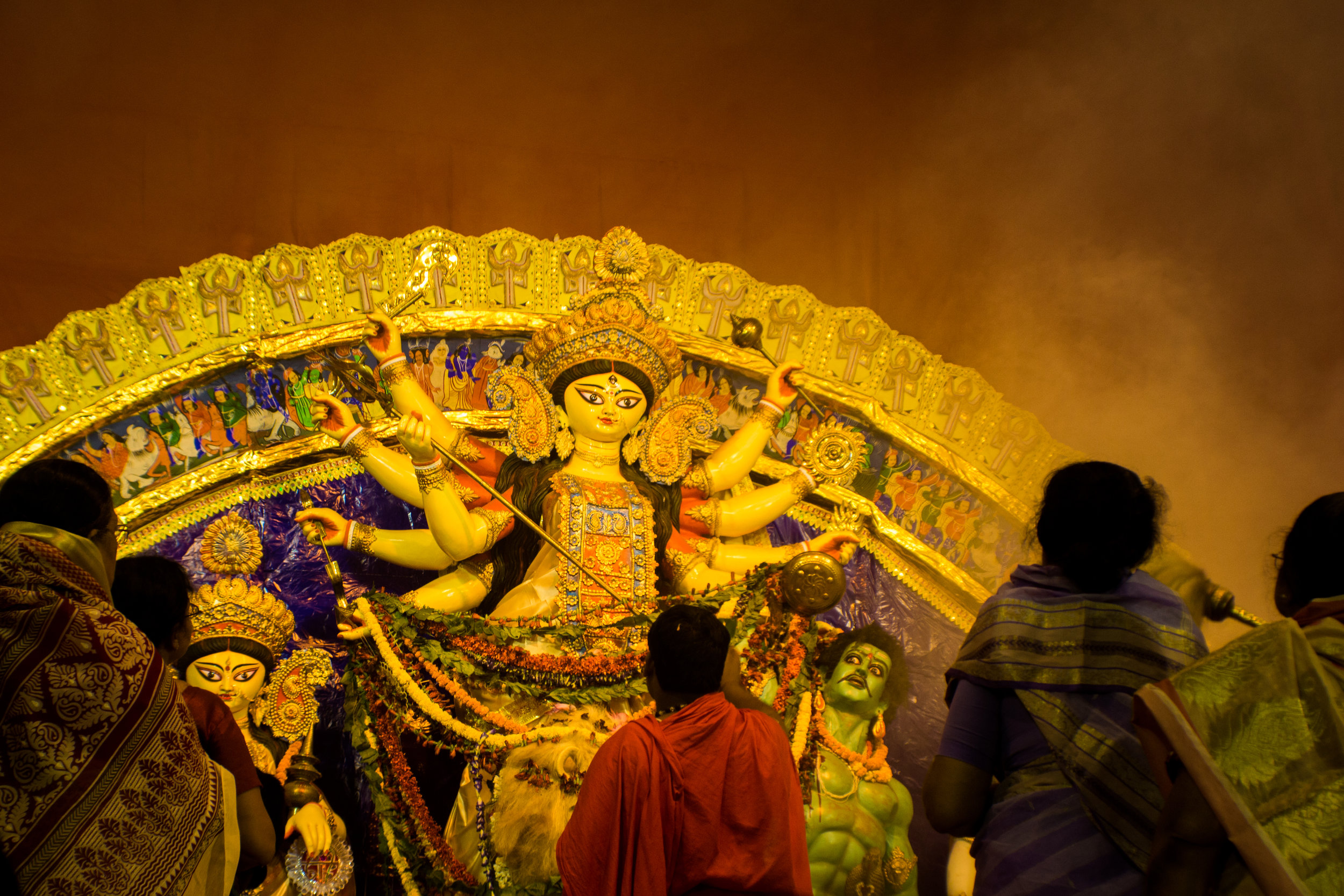
Durga Puja is a time of festivities, jubilation, and reverence for millions across Kolkata, West Bengal in India, and worldwide. These images and words capture the celebrations of the goddess Durga across Kolkata in 2018.

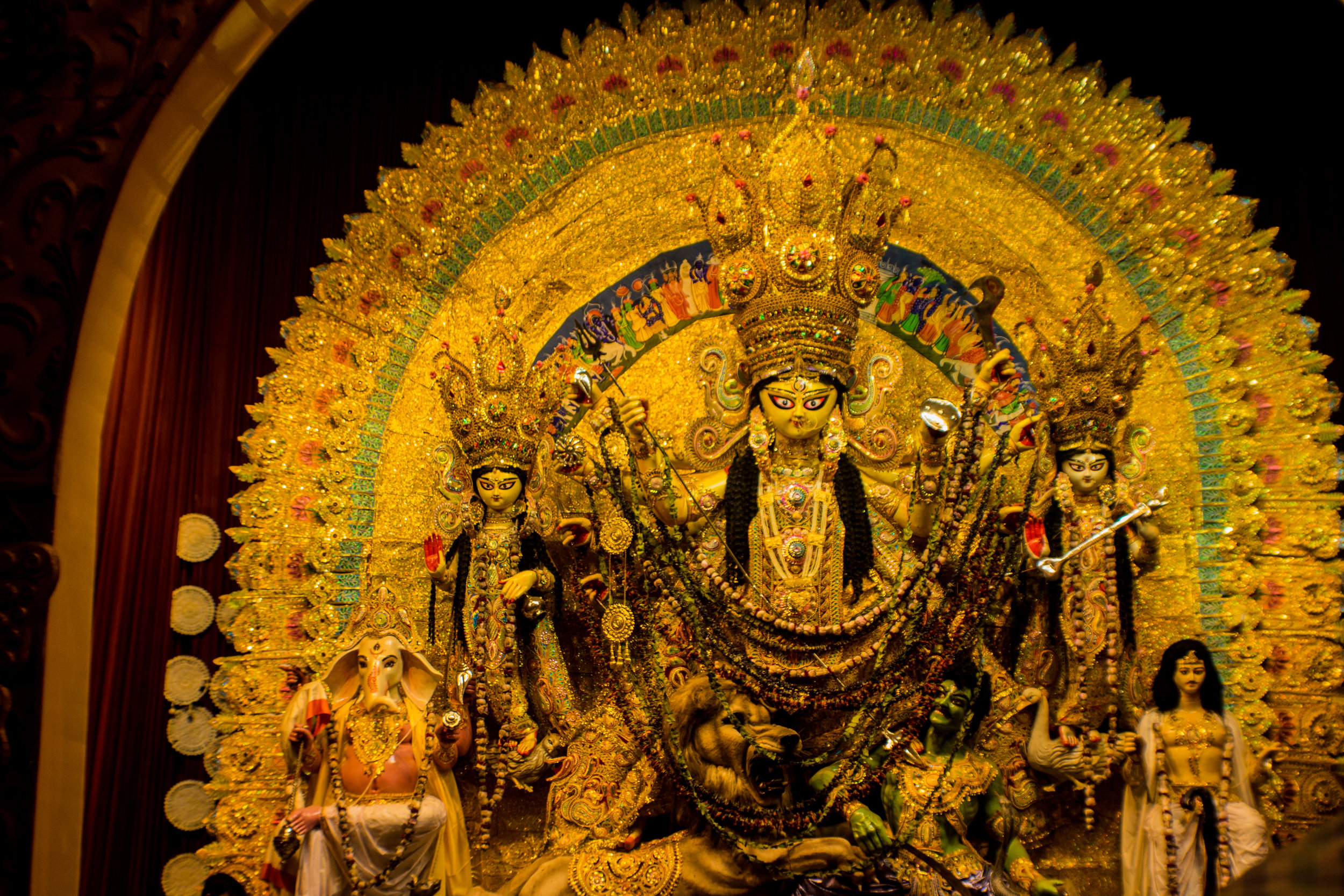
Durga Puja celebrations commemorated by the Mullick family in Central Kolkata.
Autumn is a season of festivities all around the world. Like many during this time of year, the denizens of Kolkata, India, dust off their bells and whistles for another year of jollity. For the first time since I was eleven, I was peering head-on at the basis of my identity: my namesake, the Hindu goddess Durga. In Kolkata, and particularly for Bangali Indians, this time of year is pivotal, as it is during this time that Durga is celebrated. Depending on your shade of feminism, there is much to be read into the Hindu mythology at the backbone of this festival. It is believed that at a time when the Hindu demon Asura was plotting the destruction of the universe, and no god was strong enough to defeat him, they combined their powers to create a supergod --which turned out to be Durga, a ten-handed goddess with a third eye. Yet, in today's 21st century Kolkata, Durga Puja ('puja' is any Hindu religious ritual) is hardly about inculcating a new sense of the Hindu mythology. Rather, keeping in mind the celebration of strength and vitality in the feminine form, Indians across Kolkata do what they do best: eat outrageous amounts of food, surround themselves with dance and music, and use the visits to the idols as an excuse for nighttime adventuring with friends. As I began documenting the days leading up to the festival, and each of the ten days of celebration, I bore witness to the multifaceted nature of culture and tradition, and the ways in which those have been warped and melded by time.
kumartuli.
Although Durga Puja officially occurs sometime in September or October, (This requires the leading priests in India to partake in the complex process of determining the ten most auspicious days in the Hindu calendar.) a small but meticulous community of artisans begin their work months prior. In the district of Kumartuli ("kumar" means artisan and "tuli" means locality), local sculptors and artists are commissioned by various neighborhoods in and around Kolkata to sculpt hundreds of idols using clay and other materials. These artists are fastidious, to say the least, working tirelessly to create hundreds of idols of various shapes and sizes over the course of two or three months. Each potter and artisan creates these idols with their own trademarks, and overtime many of these signatures have become recognizable to particular neighborhood where the idols are sent.

Artisans discuss the details of their craft while adding finishing touches to their sculptures, days before the start of Durga Puja.
A walk through the narrow lanes of Kumartuli during this time of year is a treat for many reasons. Rows of half painted statues of Hindu gods and goddesses line the pavements and warehouses, ready for their final makeover. Many of these sculptures are lucky enough to receive the attention and affection of frantic artists, scrambling to finish painting the eyes and noses of various holy images. As the days of quiet religious ritual have undergone their due globalized transformation, Kumartuli has become a popular place of visit by many curious and shutter happy souls, hoping to catch one last minute glimpse of an artisan working their handicraft magic.

A half finished idol is left on the side of street in Kumartuli.
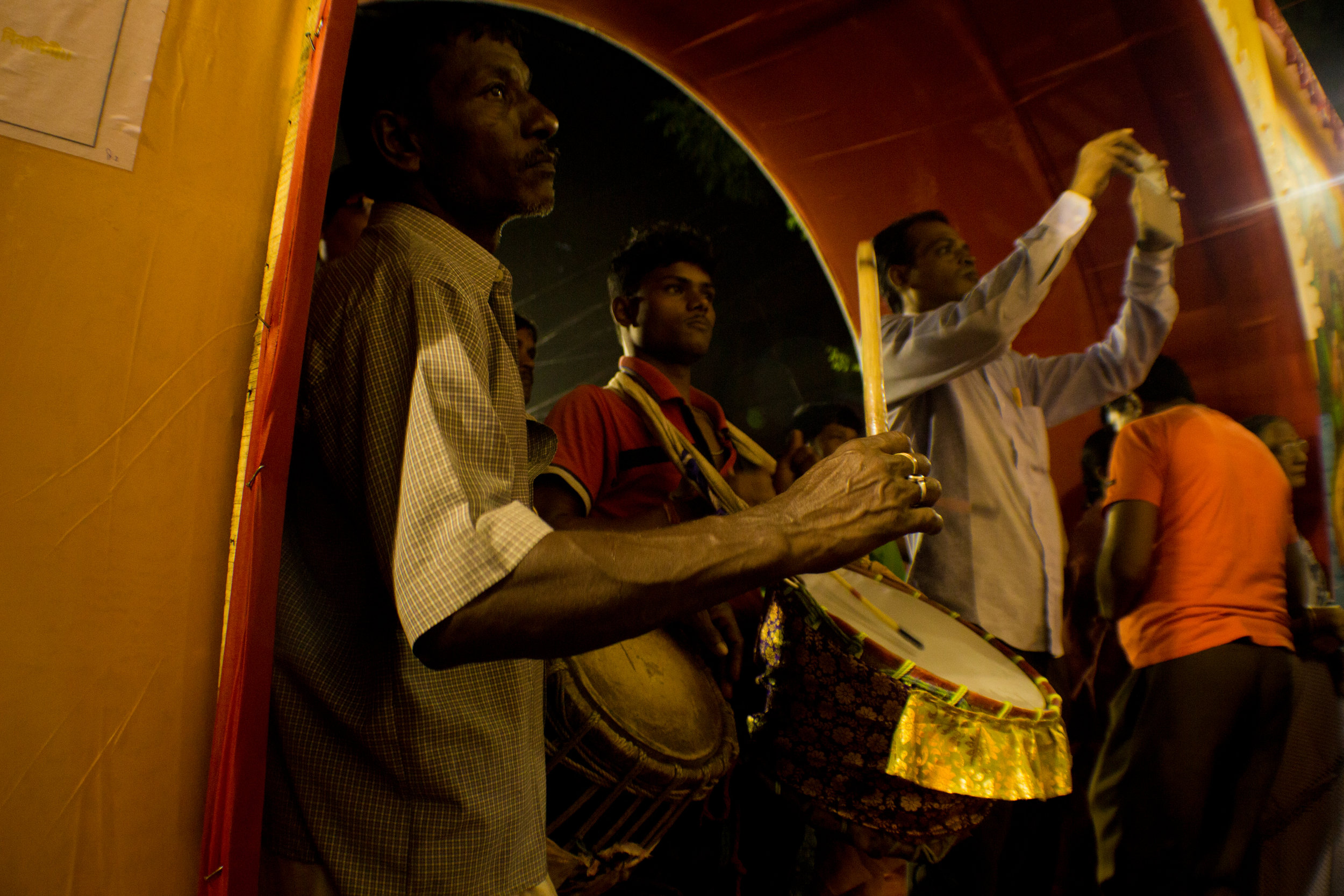
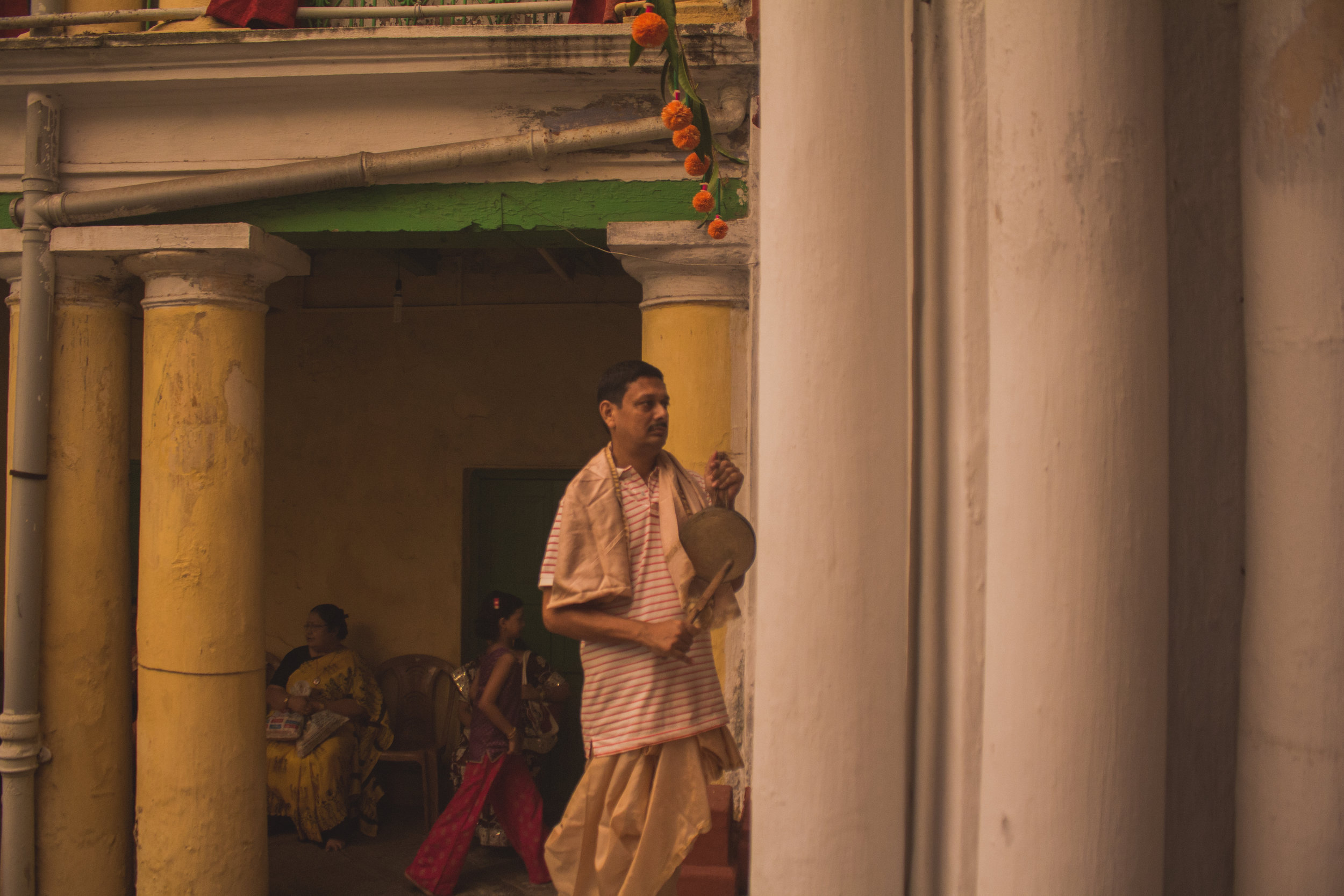
Shaped like a large barrel, a dhak is an iconic instrument in Hindu rituals. Here, two dhakis add rhythm to the ceremonies honoring the goddess Durga.
'But what happens to the sculptures after they are finished?' you wonder. Once the idols are dressed, painted, and ready to be displayed, the various clubs which commission the artisans rent large moving trucks and transport the idol to the particular neighborhood where she resides for the next ten days. However, the transportation of idols is an ordeal, which requires more than just a large moving truck and a few muscle-flexors. The idol is accompanied by locals and club members, who chant and clap to the tune of drums. A local drummer, known as a dhaki, is hired to play a particularly iconic rhythm sequence on a barrel shaped drum called a dhak, letting the city know that a goddess is being brought into the locality.
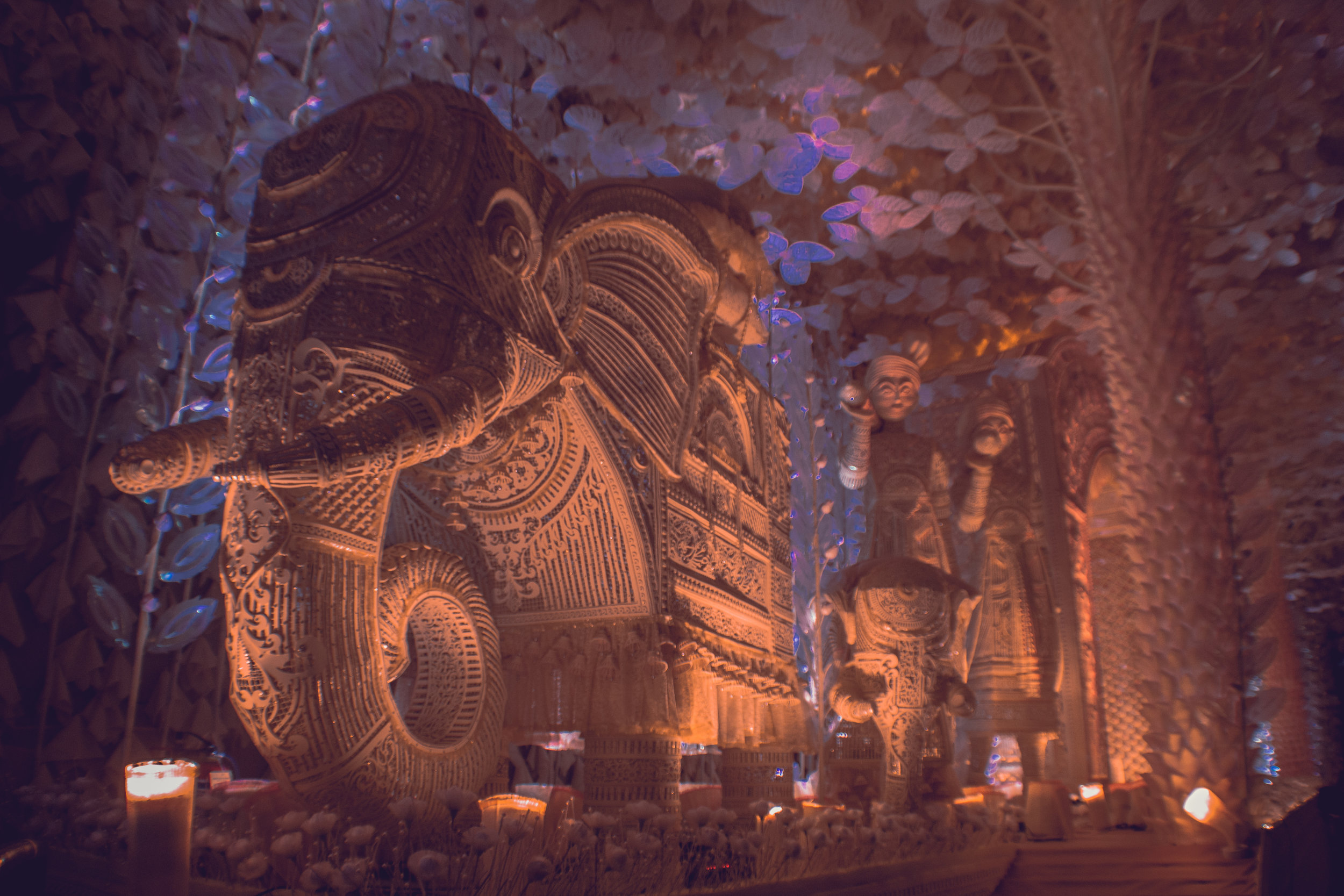
Kumartuli is not the only place where artists are in a frenzy in the weeks leading up to Durga Puja. In neighborhoods throughout Kolkata, local engineers and architects work with artists to design structures called pandals, in which the idols are housed once they are brought over from Kumartuli. In recent years, the themes of these pandals have reached new heights of imagination. From east-west fusion of Harry Potter themed pandals to this year's more abstract "how society is boxed in by modernization", the mastermind of local artists and visionaries is encapsulated into sites that are visited by hundreds of people from in and around India. Many of these pandals are placed in the middle of smaller roads and by-lanes, which complicates Kolkata traffic and adds to the general conundrum of the ten days. Kolkatans however, may be found happily consuming large amount of food, indulging in Indian music, and dancing in the streets to the sounds of the dhak, in the midst of their usual traffic complaints.

A partially finished sculpture awaits her finishing touches inside an artist's warehouse in Kumartuli, days before the start of the festival.
something old, something new.
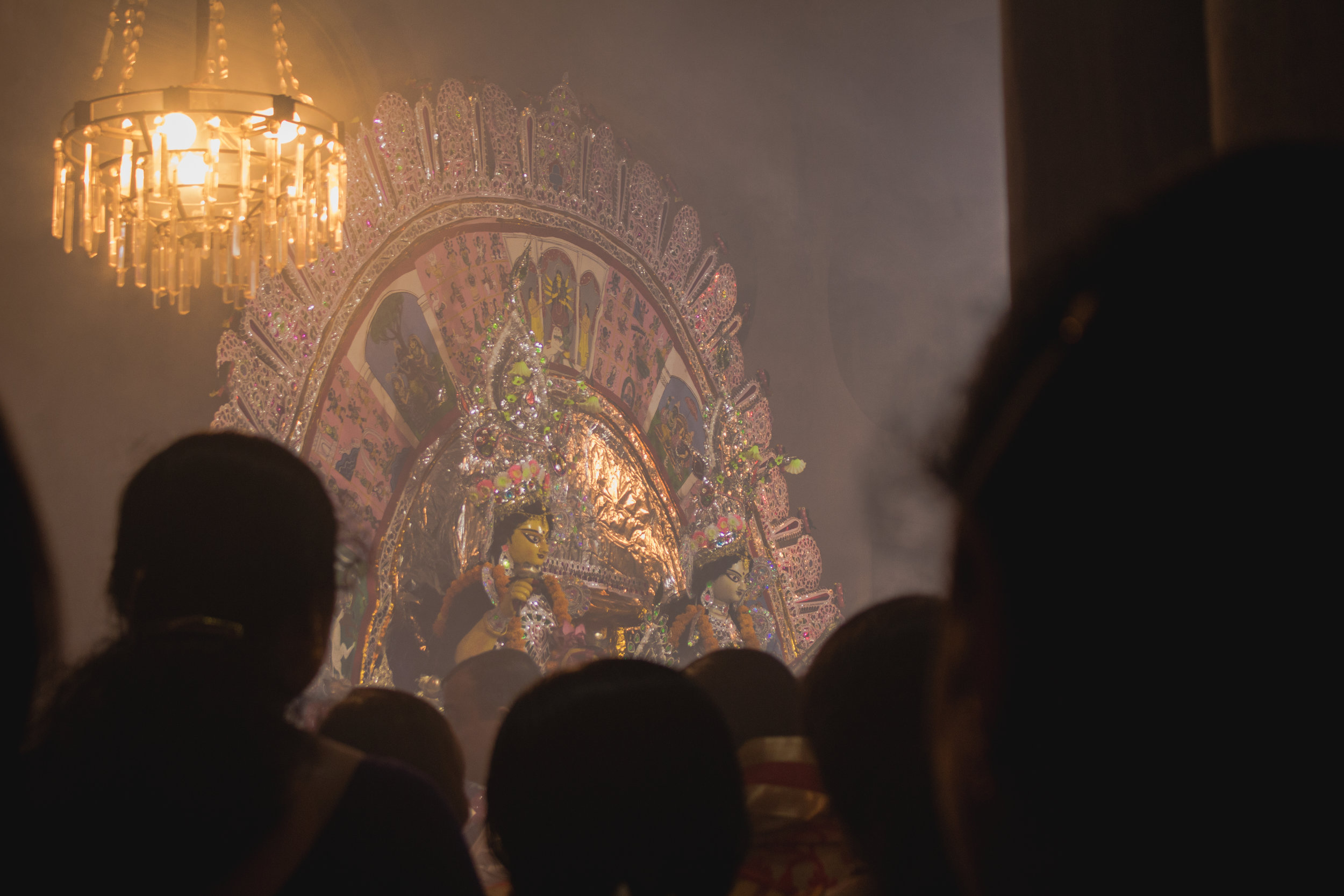
So it is the first of the ten days, and the festivities have just began. As the city wakes, hums, walks, and sleeps to the sound of the dhak, priests everywhere begin their ritual reading of the scriptures and the daily religious ceremony. During the festivities, the various localities in Kolkata tell stories of tradition. Distinctions are made between ceremonies hosted by a neighborhood club and a ceremony that has been hosted by an established family for generations. Each celebration is given a place on the ladder of tradition. Club ceremonies often carry an air of frivolity, perhaps by virtue of the amalgamation of ages and backgrounds of the organizers, and perhaps because they are a more recent phenomenon. Meanwhile, house ceremonies are typically conservative and traditional in nature, and in many cases have continued to occur for hundreds of years. Depending on whether a club or house ceremony is being attended, there is a difference in decorum and demeanor, and may generally be frequented at different hours of the day.
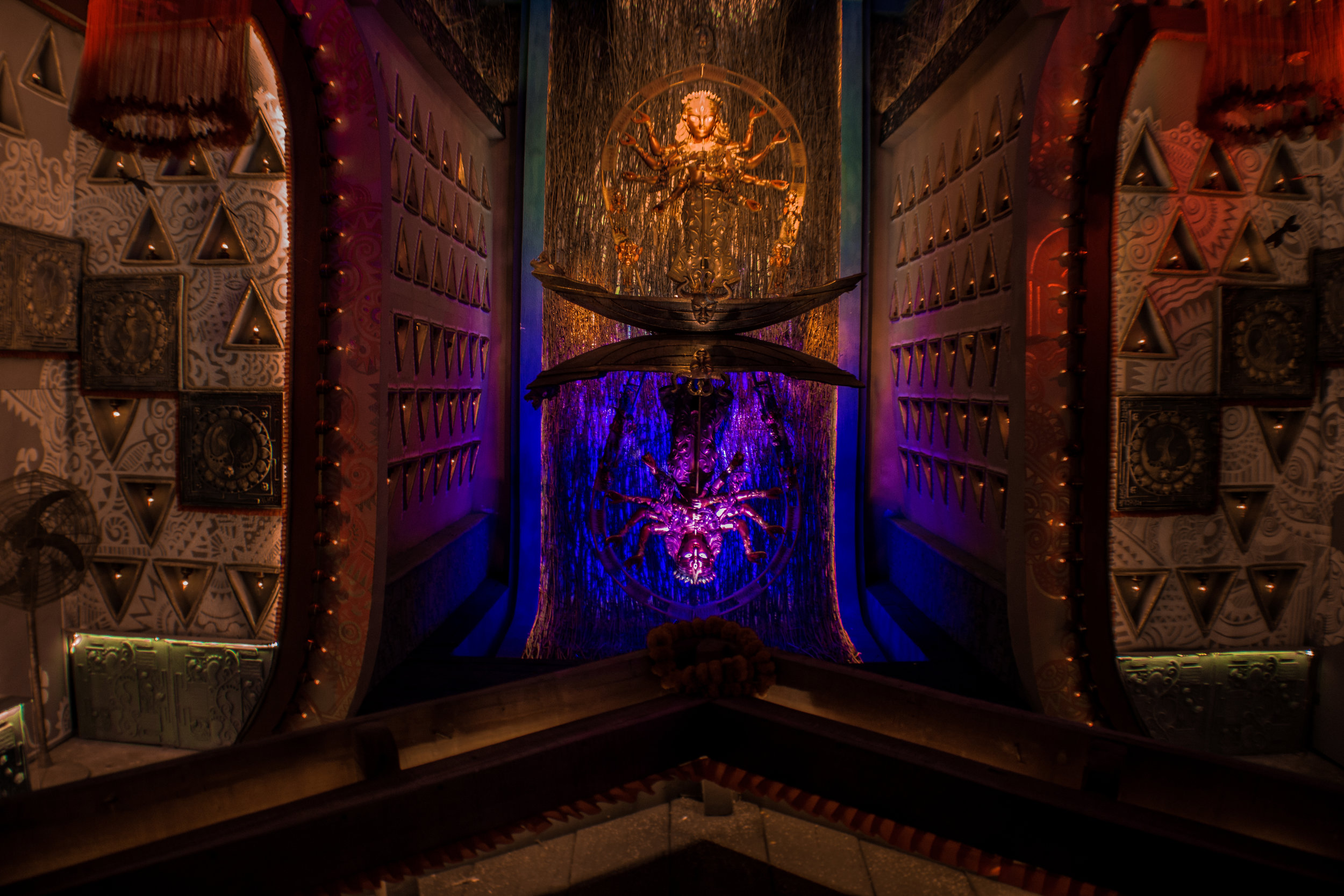
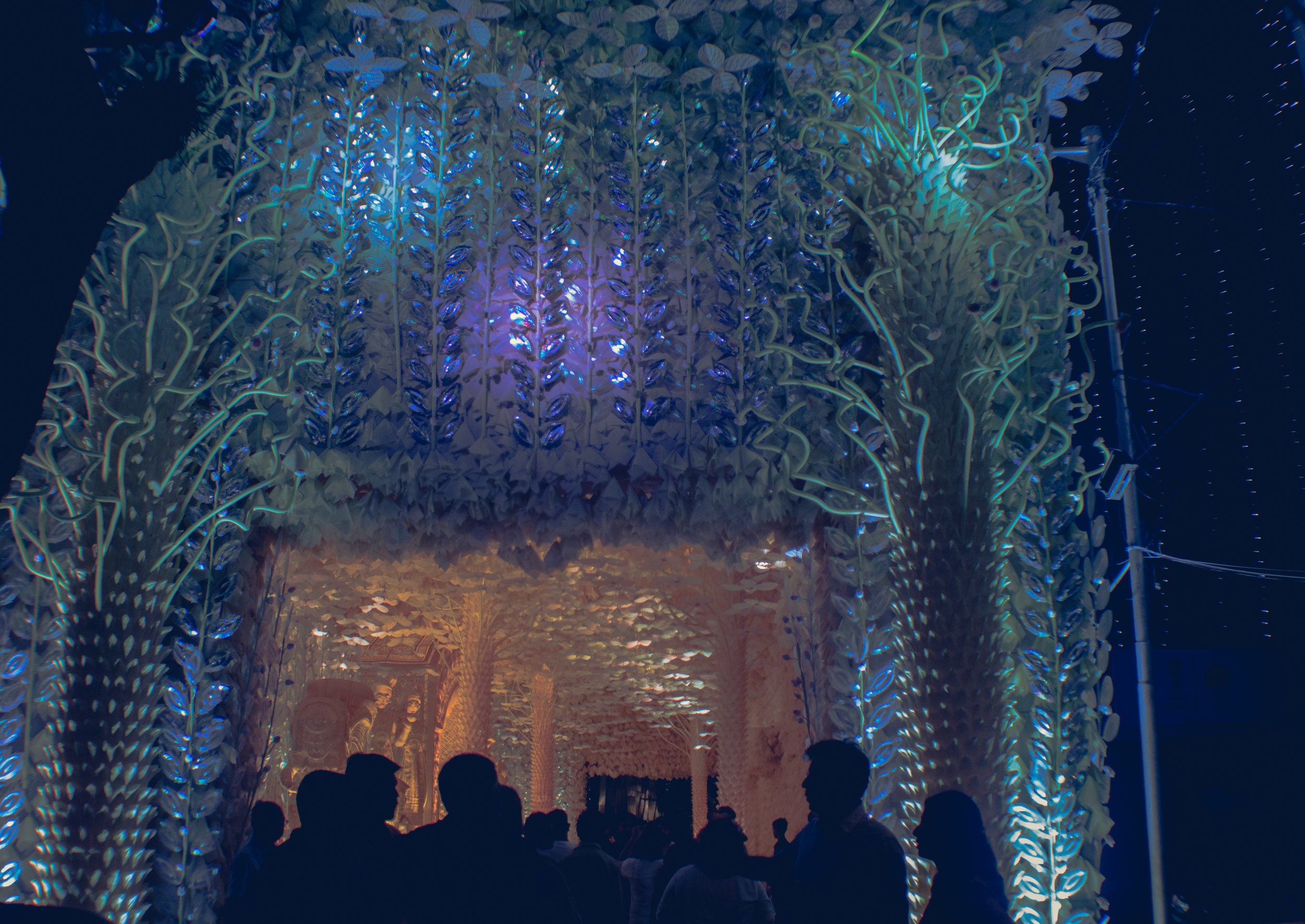
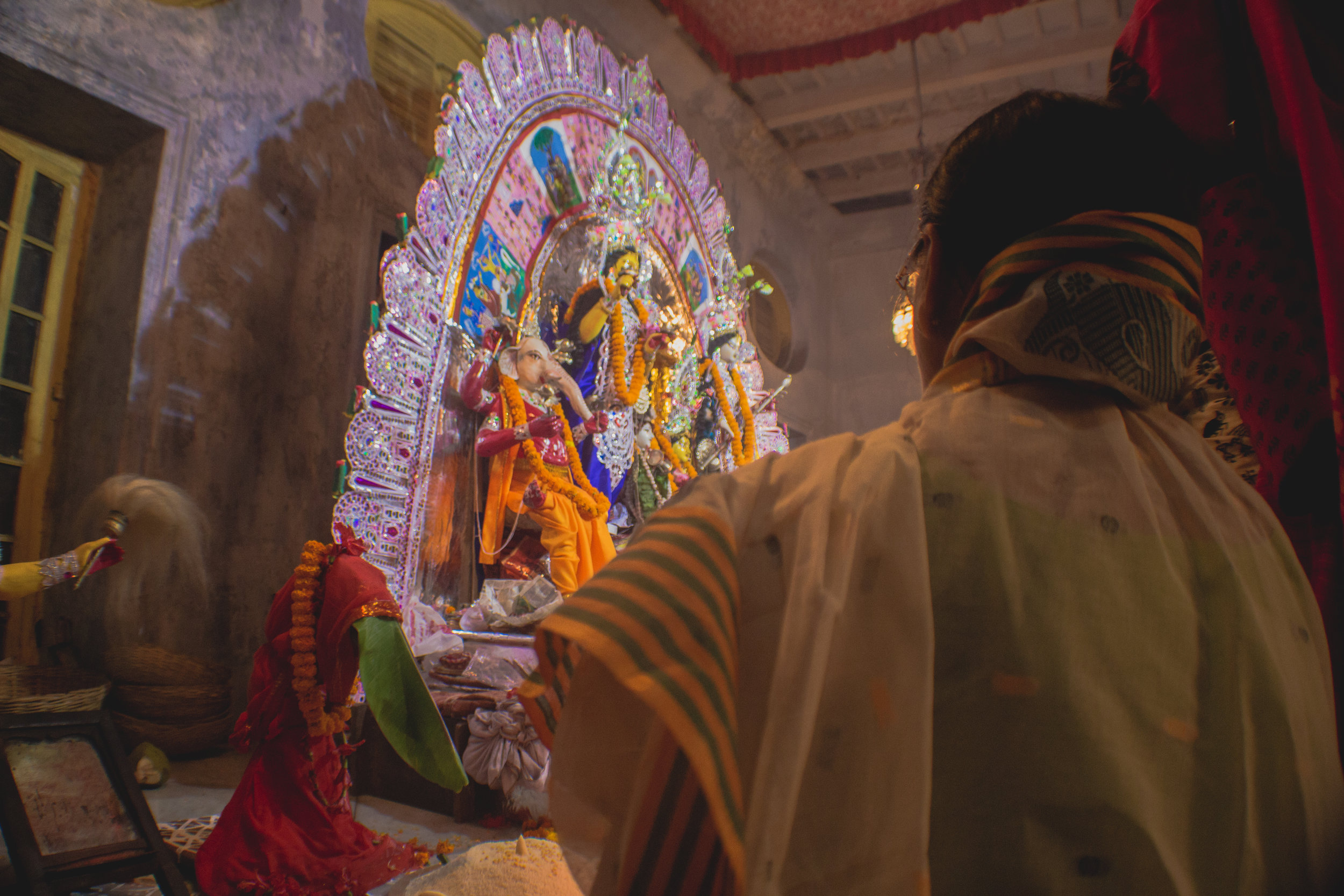
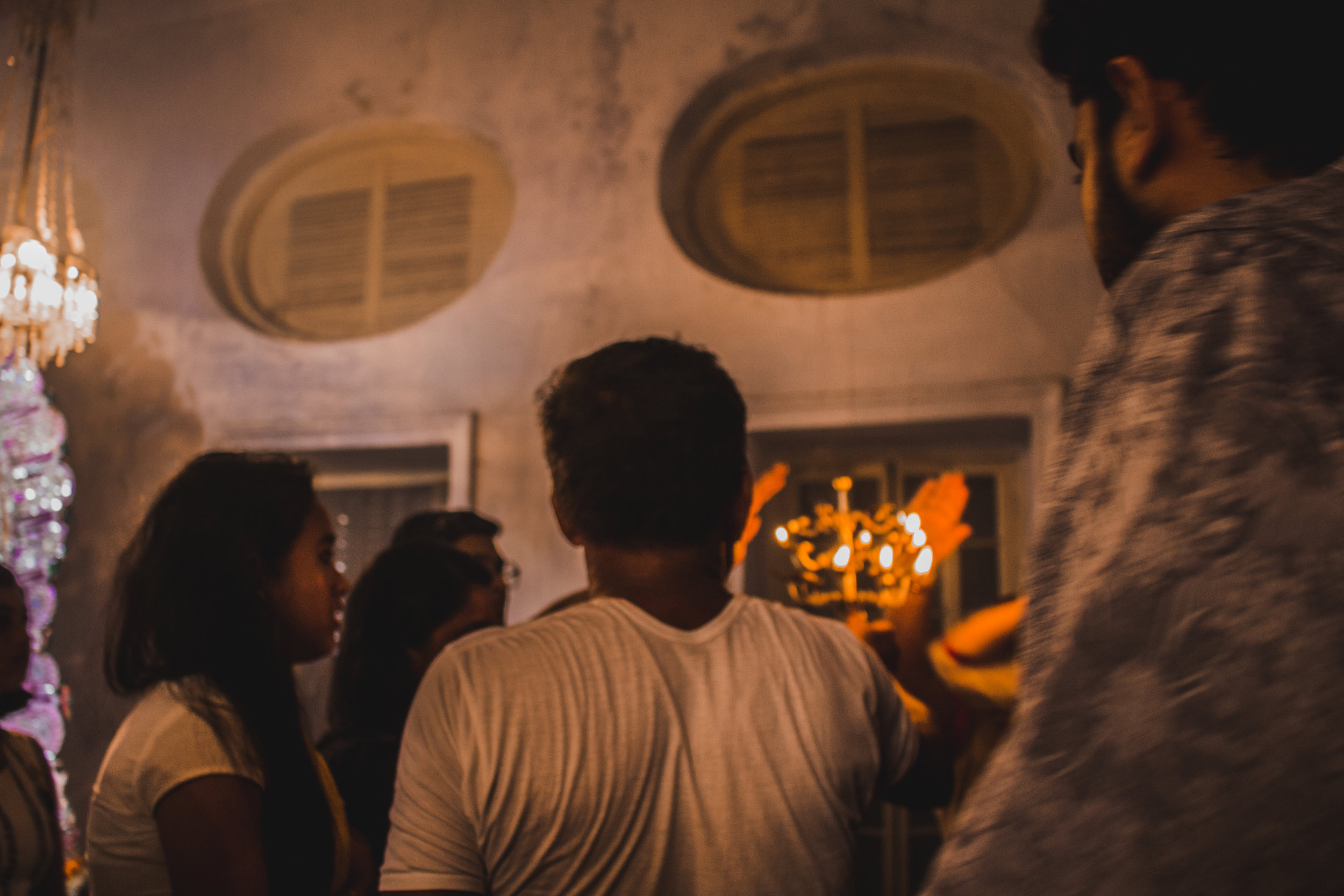
While club ceremonies entice large crowds in the evening, a house puja is predominantly a daytime affair. North Kolkata, an older region of the city, is particularly prominent for such family houses and traditional ceremonies. These ten days are serious business for such families. Typically different members of the joint family are given roles to fulfill, and often these roles have been passed down for generations. Regardless of whether it is a house puja or a club puja, however, a few things remain constant: the priest in charge of the day's ceremony offers the viewing public a chance to engage in prayer. These prayers are done with flower offerings, which are typically passed around in a basket. Everyone holds a few petals in their hands while the priest reads the appropriate passages of scripture. These flower petals are then collected back in the basket and left at the altar as an offering to the goddess. After, the priest honors the idol with flames from a lamp, which is then passed around for individuals to seek blessings from the flames. These practices are a part of most every Hindu ritual, and can be witnessed during any such auspicious ceremony.
bissarjan.
For ten days, the people of Kolkata know nothing beyond Durga Puja. Shops, offices, retailers, government buildings, banks, and more or less all other industries give into this mayhem by shutting down their respective offices. People of assorted ages roam the streets, visiting pandals and indulging in street food vices that will undoubtedly bring them ten days of gastric worries.
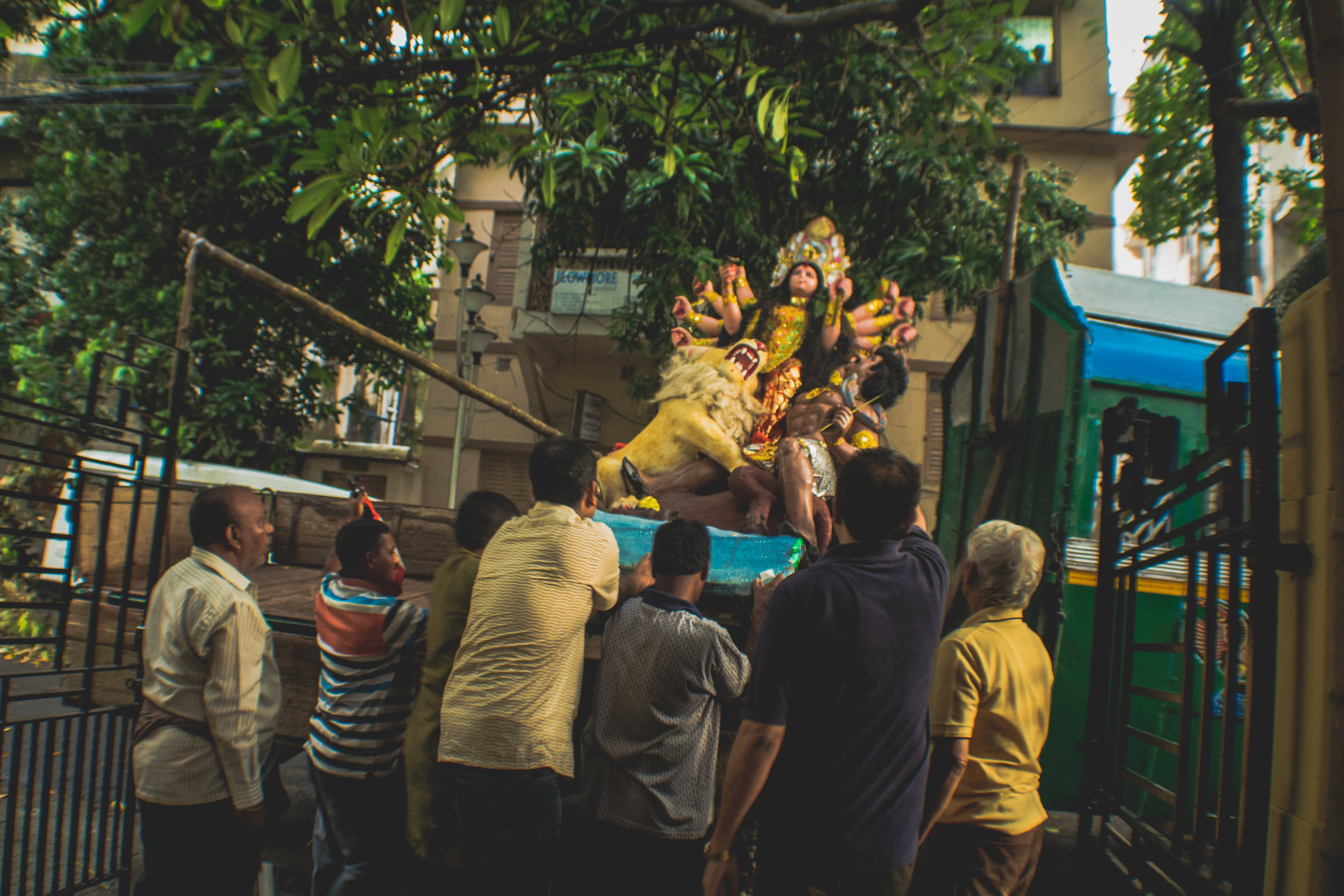
On the day of Bissarjan, family and friends of the Chatterjee family in South Kolkata heave a home idol onto a truck, to carry her to the Ganges.
Besides the Hindu belief in the creation of a goddess and the subsequent destruction of evil, it is believed that the goddess signifies a married woman, who has returned home to visit her family for ten days. Hence, these ten days are spent in a flurry of decadence and enjoyment. On the tenth day, it is time to bring the ceremony to a close, and it is time for the daughter to return to her in-laws. However, unlike Eliot's Hollow Men, for Indians, things never end with a whimper but always with a bang. The ceremonial winding down of Durga Puja is called bissarjan, the Bangla word meaning 'to end'. After the day's religious rituals are finished, the idol is placed onto a large moving truck, dhakis and locals in tow, and carried to the banks of the Ganges, where the goddess is immersed into the river.
The idol, en route to the banks of the Ganges, for her annual farewell.
The goddess, decked in all of her glory, cruises through the streets of Kolkata to the cacophony of beating drums and the infamous Bengali chant, "bolo Durga Mai ki jai! Aschhe bochhor abar hobe, bochhor bochhor abar hobe!" Hoorah to the Goddess! Next year we'll do it again, every year we'll do it again!
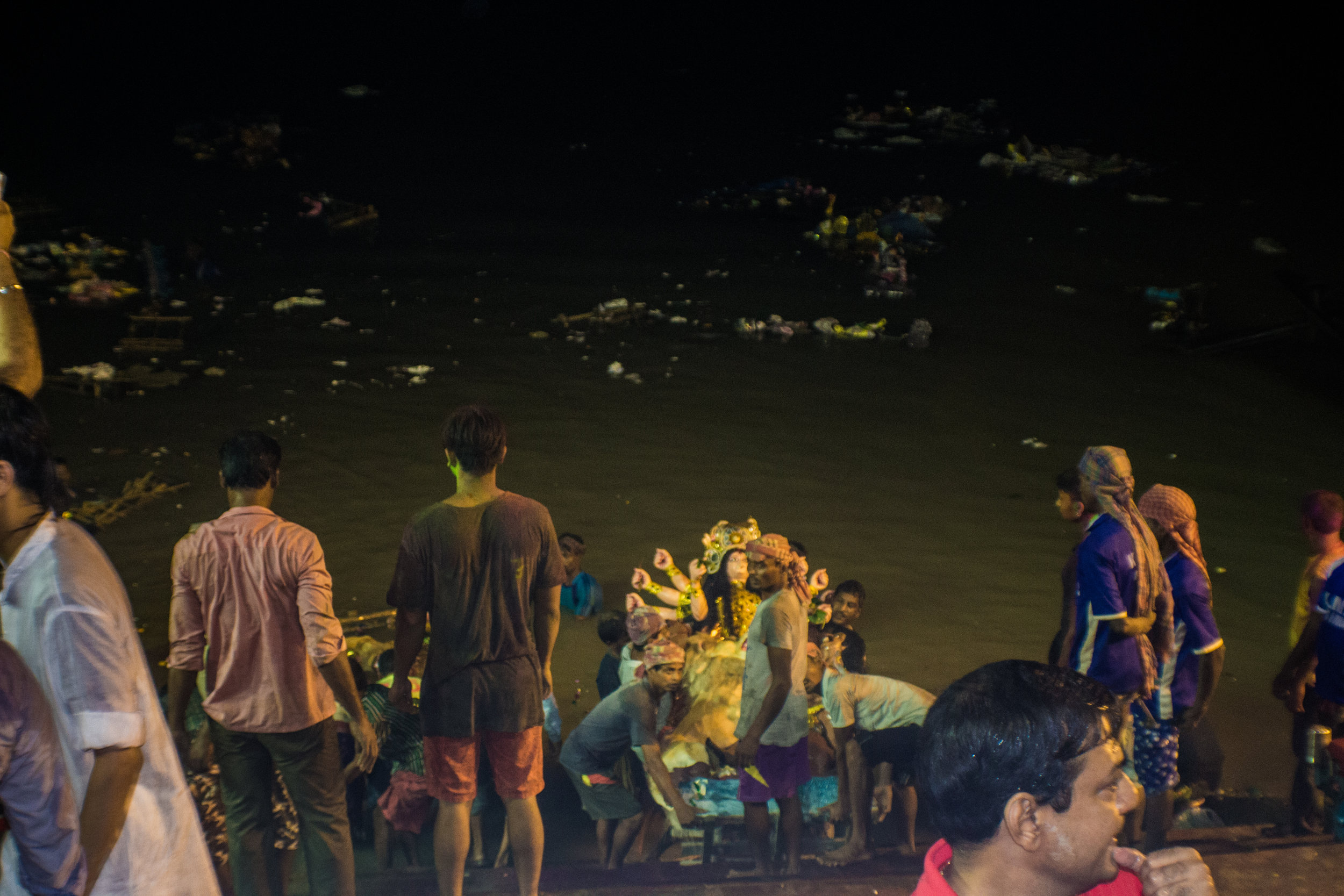
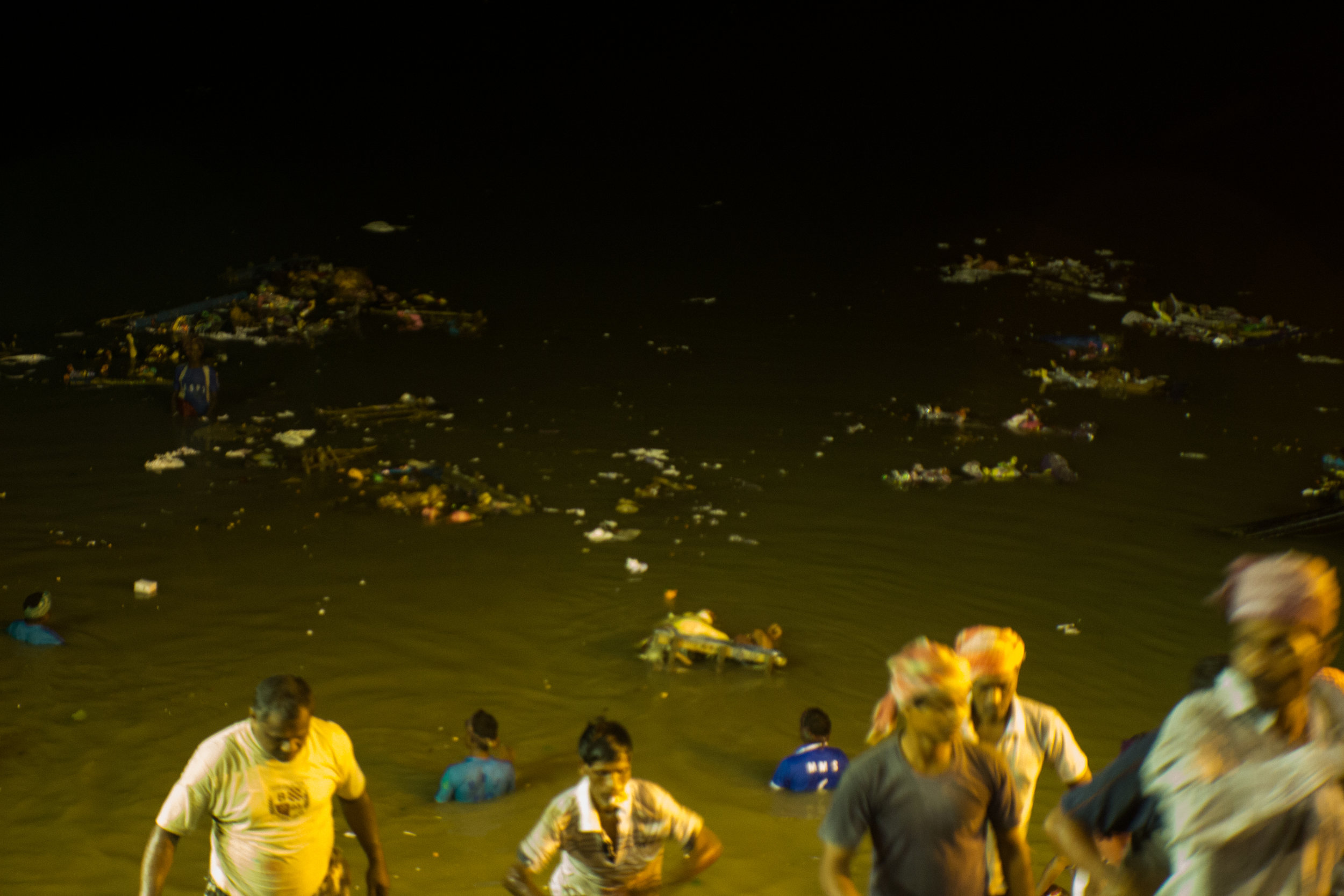
It was a surreal experience, standing along the banks of the Ganges and watching hundreds of people partake in the same ritual farewell with their respective goddesses. The idols, being made of clay, do not take very long to disintegrate with the tides of the river as they are submerged, leaving behind only the glitzy, material ornaments that float on with the piles of rubbish thrown into the water. As old traditions have been molded to dance to the new tune of modernity, lessons about the ephemeral nature of material things, and the duality of the sacred and profane are inescapable. However, perhaps most importantly and profoundly, as the entire city engages in celebrating the sacredness of the feminine strength and power, there is an inkling of hope that one day the same respect and reverence will be afforded to the women who walk amongst us.

belfast: bricks in the wall.
The city of Belfast in Northern Ireland is a stronghold of tourism, Game of Thrones filming locations, and stunning landscapes. But, it also holds the memories and traumas of The Troubles—a thirty year conflict, whose aftermath is still cemented into the fabric of the city.
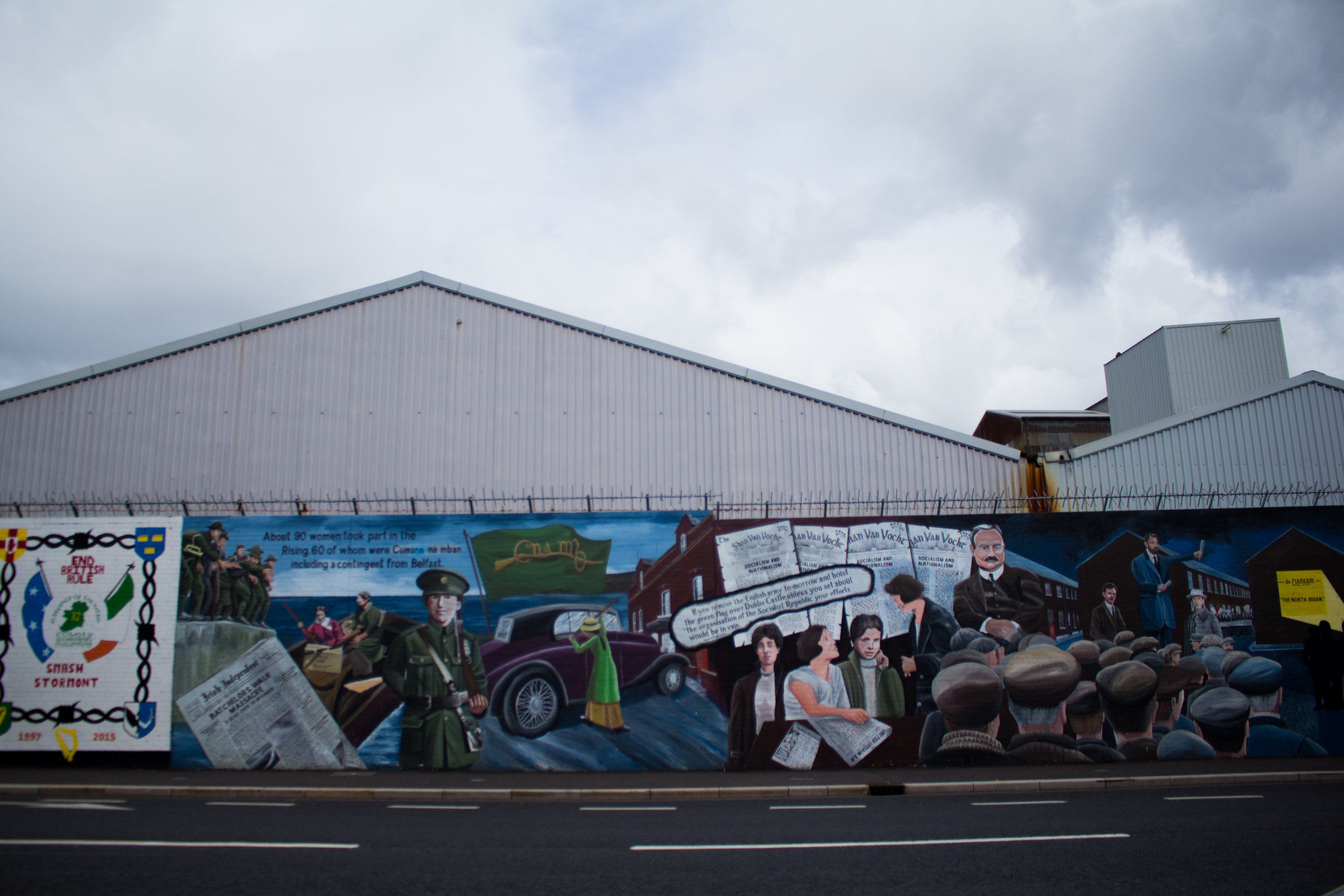
The "Peace Walls" (pictured) run along Falls Road, and through the rest of Belfast.
Belfast is not just the birthplace of the RMS Titanic. Teeming with tourists from around the world, the city is rich in history, culture, and politics. As the capital of Northern Ireland, Belfast has been at the center of much sociopolitical controversy. In 1969, when riots broke out during The Troubles, barricades were placed around the city to segregate Catholic and Protestant communities in order to prevent overwhelming violence against one and other.
On a rainy afternoon this June, I found myself at the foot of Divis Tower on Falls Road, in Belfast. Talking emphatically to a small group of people, a man named Robert made himself known as our guide for the walking tour. The few of us who had managed to brave the Irish weather had come to learn about the historic significance of these "peace walls", from individuals who had been actively engaged in the conflict. Robert was a political prisoner, who served 12 years in prison for his activism on behalf of the IRA, in the '70s. Through the course of a four hour tour, he detailed personal experiences and historic events that took place in Belfast during the conflict.
Divis Tower, a residential complex along Falls Road, was a significant starting point of the tour. At the height of the conflict, the Provisional IRA and the Irish National Liberation Army (INLA) were very active in the area, prompting the British Army to establish an observation post on the roof. In 1969, amidst riots, the Royal Ulster Constabular (RUC) fired a machine gun towards the building, claiming to defend against an oncoming sniper attack. The gunfire resulted in the death of nine-year-old Patrick Rooney, who lived in Divis Tower.

Bullet holes on the wrought iron fence that runs around Divis Tower, left from the machine gun fire conducted by the RUC in 1969.
Walking through the barricaded neighborhoods, we entered a museum. One part of the building showcased the lives of key political activists during The Troubles, their part in pivotal events, and details about the prisons in which hundreds of IRA members and nationalist activists were confined. In another room, the interior had been redone to resemble a women's prison cell from the time. The room was barely large enough to fit a twin sized bed. On a table was a thin, coarse roll of toilet paper. Prisoners would be given only three squares of this parchment like material each week for sanitation. Standing in this room, we listened to details of Robert's own experience in prison. Desperate to communicate with fellow IRA members and to push the goals of the IRA forward, prisoners would save these pieces of toilet paper to write informative notes. Folding a single square until the paper was less than an inch wide, Robert explained that he and fellow activists would place the paper inside their mouth, against the side of their cheek prior to meeting with the IRA members who would come to visit. The members would pretend to be family, in order to be allowed visitation rights. Upon meeting one and other, the imprisoned activists would discreetly pass on the note. Such information was crucial in allowing the IRA to continue their efforts to organize against the British government. However, such actions also meant sacrificing any nominal guarantee to sanitary conditions in the cell. As it became clear, there were no toilets in the cell, and prisoners were not allowed to leave the room. Robert recalled that sometimes feces would collect in the room until he was compelled to use his own hands to smear it against the wall, to make room.
“The IRA were very clear about two things that would happen: one you’d go into prison, and the other that you would end up in the cemetery. I was one of the lucky ones.”
Our tour ended at the Milltown Cemetery, where many activists and members of the IRA are buried today. Like many of his peers, Robert joined the IRA when he was barely an adult, and he quickly learned the realities of joining the movement. Each member was told to understand that imprisonment and death were inevitable. Gesturing towards the tombstones Robert said, "I was one of the lucky ones."

Imprisoned for 12 years for his activism with the IRA during The Troubles, today Robert (pictured) works as a guide for the mural tours around Belfast.
The violence during The Troubles is hardly a thing of the past. Since the signing of the Good Friday Agreement, new walls have been built to counteract persisting hostile conditions. Individuals had been shot and killed as recently as the previous year, and the community constructed walls and implemented curfews to keep violence from both sides at bay.
As walls and barriers resurface as political talking points today, the history and reality of segregated communities must not be neglected. On the one hand, the walls perpetuate social divisiveness, but on the other, they attempt to record and retell stories of struggle and solidarity. In many neighborhoods, the walls run for miles on end, but are painted by local artists with vignettes showcasing major events or individuals who demonstrated resilience at the time of the conflict. Today, many former IRA members like Robert, who had once been imprisoned for their part in the conflict, serve as guides on mural tours around Belfast. They share their stories, detail a part of the history of their community, and hope that the youth of today will learn from their trials and tribulations.

A segment of the "peace wall" that runs along Falls Road.

skellig islands: in search of solitude.
This is a story about my journey to the remote island monasteries of Skellig, which were built by monks between the 6th and 8th centuries.
Little Skellig, home to hundreds of different species of birds, seen from Skellig Michael.
Serendipity is the only way to describe my trip to the Skellig Islands.
Having found out about the islands only a week before my scheduled arrival in Ireland, I found myself rejected by every tour company, owed to the fact that it was summer and they were fully booked. The evening before my intended travel to Skellig I received an offer to join one of the tour companies, given a last minute cancellation.
Skellig Michael, the island from which this photograph was taken, is said to be inhabited by Christian monks in the 6th century. These monks laid an estimated 600 steps to the top of the island, on which they built a monastery entirely out of rocks. In the 16th century, Skellig Michael became a site of pilgrimage, but much of the history of the islands remains a mystery due to a dearth of historical records.
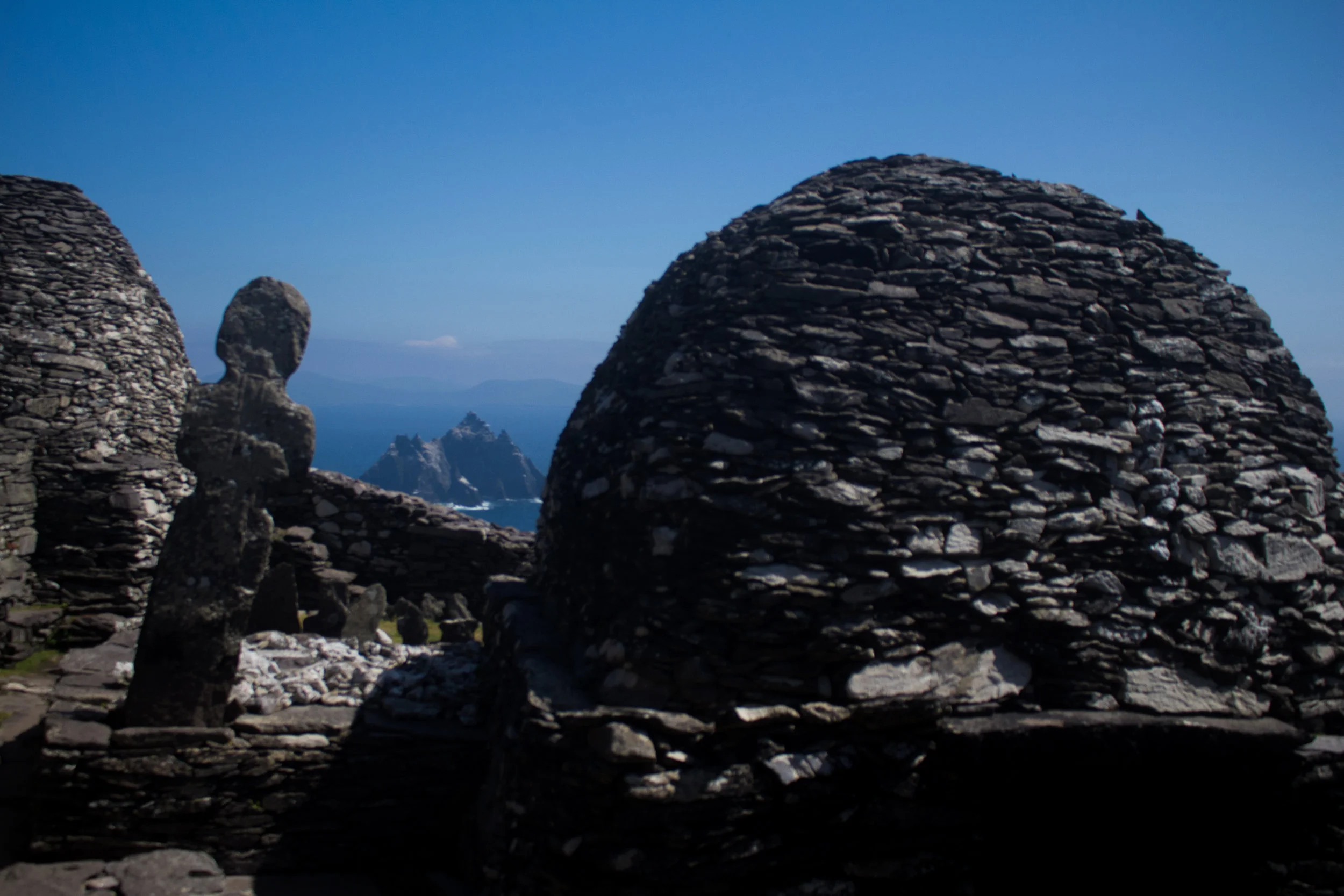
Beehive shaped monastic structures, atop Skellig Michael.
It just so happened that on the Thursday I travelled to the islands, it was the hottest day in the entire month of May in Ireland. Graced by various forces of the environment, I began my journey to the Skelligs with an hour-long boat ride on the Atlantic Ocean. Upon landing on Skellig Michael, I started my trek up the 600 uneven steps. Although the weather was impeccable, the wind billowed about 30 miles per hour, unobstructed by the endless ocean and open space around the island. With every step upward, I reflected on how 6th century monks managed to brave the weather and environment in order to live on the islands in such austere conditions.
On such tour days, the island is milling with people. Some come to Skellig due to Star Wars fame, and others for their personal convictions. Yet, despite the humming of human voices, somehow it becomes easy to find solitude, standing on such a historic intricacy. Vast, engulfing ocean, roaring wind, and you.